Monday, May 5, 2008

Mikhail Gorbachev and the Collapse of Communism


At 54, Mikhail Gorbachev was the youngest Soviet leader since Stalin.Unlike other Soviet leaders, Gorbachev had not needed to blindly follow Stalin’s policies. He could pursue new ideas. The Soviet Union was a totalitarian state, it rewarded silence and encouraged individuals from acting on their own, the Soviet society rarely changed. Gorbachev realized that economic and social reforms could not occur without a free flow of ideas and information.
In 1985, Gorbachev announced a policy known as glasnost, he encouraged citizens to discuss ways to improve their society. Glasnost brought remarkable changes. Glasnost is a Soviet policy which permits open discussion of political and social issues and freer dissemination of news and information. In 1985, Gorbachev introduced the idea of perestroika. Perestroika is an economic policy to decentralize the Soviet economy. The term translates to "restructuring" in Russian.

Friday, May 2, 2008

Collapse Of Communism


The fall of Communism was a major turning point in history. The Cold War ended, Diplomats, finally had an opportunity to enter the Soviet Union without military aid,and the Berlin Wall came crashing down. Communist Governments first lost power in Poland in June 1989. Demands for reform spread across East Germany in the fall of 1989 and led to the destruction of the Berlin Wall and the unification of East and West Germany.

Monday, April 21, 2008

Nelson Mandela and Apartheid


Apartheid is discrimination based on race and the color of skin. Until 1991 the White government of South Africa ran a system of apartheid whereby Black people were given less access to employment, health and education and were kept separate from the White population. South African blacks were segregated into reserves known as ‘homelands’ and subjected to residential and occupational restrictions. Apartheid was maintained by a wide range of laws that included the prohibition of inter-racial sexual intercourse or marriage and outlawed racially integrated political and social organizations.
Nelson Mandela was the first President of South Africa to be elected in fully-representative democratic elections. He was an anti-apartheid activist and leader of the African National Congress. He spent 27 years in prison on convictions for crimes that included sabotage committed while he tried to end apartheid. Among opponents of apartheid in South Africa and internationally, he became a symbol of freedom and equality.

Wednesday, April 16, 2008

African Independence


Like the Asian countries, the countries of Africa were unwilling to return to colonial domination after World War II.Between the two world wars, an educated middle class had begun to emerge in African cities. French-speaking Africans and West Indians began to express their growing sense of black consciousness and pride in traditional Africa. They formed the Negritude movement—a movement to celebrate African culture, heritage, and values.
The British colony of the Gold Coast became the first African colony south of the Sahara to achieve independence.On receiving its independence in 1957, the Gold Coast took the name Ghana. Ghana became the first nation governed by black Africans
to join the British Commonwealth. Kwame Nkrumah became Ghana’s first prime minister and later its president for life. Nkrumah pushed through expensive development plans and economic projects, new roads, new schools, and expanded health facilities.
Mau Mau, was a secret society made up mostly of Kikuyu farmers forced out of tge highlands by the British. Their aim was primarily to frighten the white farmers into leaving the highlands.
On 1955, most of the countries in Africa were colonies, after 1975, most of these colonies became independent countries.

Tuesday, April 1, 2008

The Cuban Missiles Crisis


Fifteen years into the cold war, the new American president and the Soviet premier met in Vienna to discuss the east-west confrontation. They resolved nothing. The superpowers continued to increase their military strength. The Soviets felt threatened because the U.S. still had more missiles. Some of those missiles were based in Turkey. These tensions eventually led to a confrontation in Cuba.
The crisis began on Monday, October 15, when photos revealed SS-4 nuclear missiles in Cuba. This confrontation lasted 14 days. On Sunday, October 28, Premier Nikita Khrushchev, announced over the radio that the Soviets would dismantle their nuclear missiles in Cuba.

Monday, March 31, 2008

NATO and The Warsaw Pact


After World War II, the countries of Western Europe found themselves too politically and militarilly weak to prevent the spread of the communist "iron curtain" on a national level. Little time passed before the weakness was realized and Western Europe turned to a more inclusive North Atlantic Treaty. The North Atlantic Treaty Organization (NATO) is an alliance of 26 countries from North America and Europe commited to fulfilling the goals of the North Atlantic Treaty signed on April 4, 1949. The fundamental role of NATO is to safeguard the freedom and security of its member countries politically and military means.
Established 6 years after NATO, the Warsaw Pact was formed as a communist military alliance to maintain power over Eastern Europe. The Soviet Union gained control over both neighboring European nations and indicated to other nations that it was a major miliotary and political force. Although the ground forces of possessed by the Warsaw Pact were far supirior to those of NATO, their technology fell far behind. After many democratic revolutions within the Warsaw Pact it was labeled "nonexistant" in 1991.

"The Right Stuff"


In the film "The Right Stuff", the United States and Russia were always competing against each other to become a better country. In the film, the competition started after the United States broke the sound barrier. After this accomplishment made by the United States, Russia launched the first outer spacesatellite, Sputnik. To make themselves better than the Russians, The United Stated tried to put the first man in space, but failed, and ended up putting the first chimpanzee in outer space. The scenes from the film that will help me remember the Cold War event is the scenes in which we see the planes and the sound barrier being broken.

Thursday, March 20, 2008

"Schindler's List"


Schindler's List is a very powerful film that represents the Holocaust. This film was made from the perspective of a Nazi, who was trying to help the Jews. I think that the film was a good representation of the Holocaust because it showed all the suffering that the Jews went through, from living in the Ghettos to working in the Concentration Camps.
I think that the whole movie was full of strong scenes, but three of the most powerful scenes were the liquidation of the Krakow ghetto, the labor camp, and the children in the streets. One of the really sad scenes was when the little was walking by herself and then she went inside a house and hid under the bed.
The scene when the guy in control of the concentration camp walks out from his room into the balcony smoking a cigarette, and then he picks up his weapon and shoots a woman down in the ground for no reason is an image that will stay with me. This image was very powerful because it showed how invincible the Nazis were and how they only cared about themselves, it also shows that the only reason he shot the woman was because he was bored and had nothing else to do.

"Night and Fog"


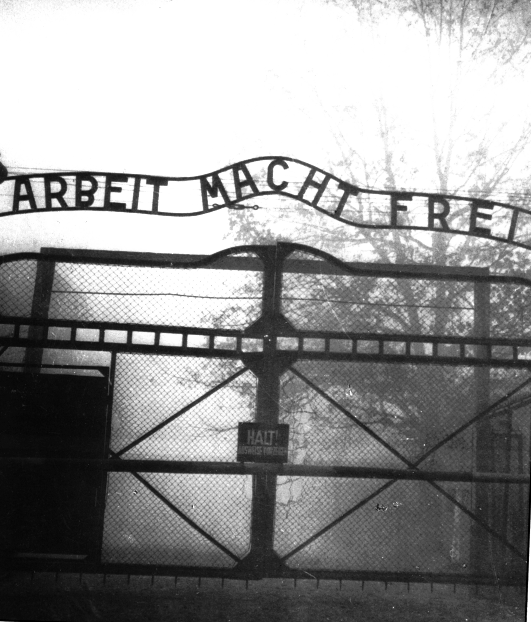
"Night and Fog" is a documentary based on the Holocaust. This documentary was recorded ten years later in the concentration camp of Auschwitz. In the documentary, we saw the barracks, the barbed wires, the crematoria,the watchtowers, and even the bathrooms. It was unbelievable to watch these places, and also to see and listen to the flashbacks. It was harsh to listen to the cries and the screams of the victims. It is amazing and hard to believe that people were able to live and and some of them even strong enough to survive and go on with their lives.
I found the film very powerful, because it didn't only take you through the places where these people spent horrible days, but it also showed flashbacks to show the experiences that people went through while at these camps. The scenes from "Night and Fog" were different from the scenes in "Schindler's List", I think that the scenes from "Night and Fog" were more real, because these images were actually real and they were not made in a Hollywood studio.
But I do believe that the film that explains the Holocaust more effectively is the Hollywood version. I think this becuase in the Hollywood version, unlike in the documentary, we got to see what it was like when the people were in the "Ghettos" and how it was like when they were being evacuated. It also showed the suffering that the people went through while at the concentration camps, things that the documentary did not show because it was just based on the concentration camp, but it still provided a good explanation of the Holocaust.

Monday, February 11, 2008

The Treaty of Versailles (ended WWI)


The Treaty Of Versailles, was signed on June 28, 1919. The United States, Great Britain, France, Italy and other allied states, met to impose territorial, military and economic treaty terms on defeated Germany. German representatives were not allowed to participate in the treaty's negotiation, and the terms were not negotiable. Germany signed the Treaty on June 28, 1919, even thought German leaders rejected the treaty's contents.
The Treaty of Versailles, blamed Germany completely for the causes of World War I, it also forced Germany to pay compensation to the allies. As a result, Germany lost many land and its overseas colonies were taken away and shared between the allies. 12.5 of Germany's population found itself living outside the German borders.
The Nazi Party, started out as a small party, known as the German's workers party. The members of this party, were against the Treaty of Versailles and communism. Hitler joined this party,his enthusiasm led him to the leadership of the party very quickly.
Many historians believe that the Treaty of Versailles led to the rise Fascism and Adolf Hitler. I think that they say this because the Nazi Party was started by people who were against the Treaty of Versailles, because of the punishment that was bestowed on Germany.

Friday, February 8, 2008

Mustafa Kemal (Ataturk) and the Modernization of Turkey


Mustafa Kemal was born in 1881, he is known as the founder of the Republic of Turkey. Mustafa Kemal was the first president of Turkey, and is also known as the "Atatürk" meaning the Father of the Turks. In 1919, he became the leader of the Turkish National Liberation struggle. On 1923, Atatürk established a form of government. Between 1926 and 1930, legal changes led to the abolishment of Islamic religious and led to the beginning of a Secular System.
Mustafa Kemal initiated a program for economic development in his country, this program consisted of agricultural expansion, industrial and technological advances. He did not stop there, in 1928, he abolished the Arabic script and incorporated the Latin alphabet with his people. After this, the force to develop education emerged. Primary Education was declared an obligation and Woman's Education became a very important issue.
Mustafa Kemal "Ataturk" was Turkey's president for 15 years, until his death on November 10th, 1938.

Thursday, February 7, 2008

Film Lesson "Gandhi"


Gandhi influenced Indian Independence in many ways. Gandhi wanted to unified his people, because he believed that didn't work together, Britain will easily defeat them. Gandhi encouraged Indians to protest against Great Britain by buying Indian goods instead of Britain's. Indians made their own cloths, and salt from the Sea, so that they didn't have to buy it from the British. Gandhi preached Passive Resistance, he believed that violence will only result in more violence. After the Amritsar Massacre on April 13, 1919, people grew tired of being mistreated by Britain and they decided to fight back, but Gandhi still didn't support violence. When Indians used violence against the British, or when he was imprisoned he would go on hunger strikes. In 1930, Gandhi led a non-violence march, protesting the British Salt Tax, the Salt Tax, prevented people to make their own salt, so that they will buy the British salt.
Gandhi was mostly known for his preaching against violence. He told his people to never fight back against the British, because if they did it will make them more violent. On 1931, Gandhi made a trip to Britain for a Round Table Conference, but nothing was achieved. On 1947, India gained its independence from Britain. Gandhi was not happy with this, because he wanted Indians and Muslims to live together, but India was divided into Pakistan for Muslims and India for Hindus. Gandhi was murdered on January 30, 1948 by a Hindu who couldn't forgive him for believing that Muslims had equal values as Hindus.